
Bradley R Fulton, PhD
Director, Research and Analytics
If a carrier wants to understand their drivers’ feelings about work-related issues, they need to ask. The most efficient and effective method is through a survey—a carrier can ask about a host of issues using measures that have been quality tested. This method is especially effective with young drivers who are accustomed to online surveys and who want to be heard.
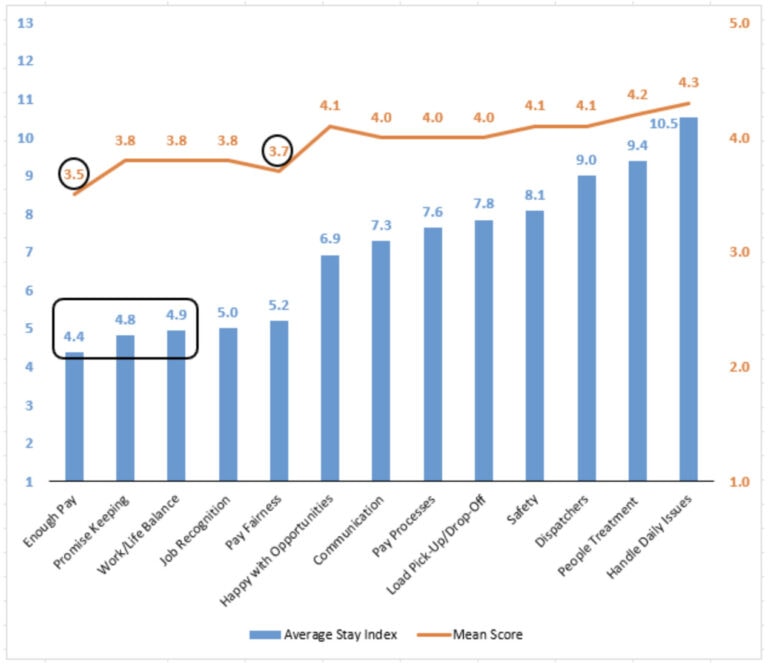
To better understand the perspective of the industry’s youngest drivers, Tenstreet analyzed 930 responses to a 13-question survey completed by drivers under 30. Collected over the past year, the surveys represent drivers from 50 different carriers. A statistic called the Stay Index was computed for all 13 items for each carrier. The Stay Index allows carriers to identify issues that are both (1) low performing, and (2) important to drivers. Focusing only on performance, a carrier risks failing to improve issues drivers care the most about. The Stay Index ranges from 1 to 13. Lower ranking items (closer to 1) indicate items that are low performing and important to drivers. These are the issues to focus on!
The item with the lowest average score (indicating performance alone), pertains to enough pay. Not surprising. On a scale of 1 (strongly disagree) to 5 (strongly agree) the average is 3.5 – just above neutral. The next item is pay fairness (e.g., pay compared to other carriers) with an average of 3.7. So, should we focus on pay?
When factoring in the Stay Index, which incorporates the importance drivers place on each item, we gain a much richer picture. Only three items had an average Stay Index less than 5. These pertain to issues of enough pay, promise-keeping, and work-life balance.
Consider a young driver’s perspective. Even with broad industry knowledge, they have little to no experience. They trust those with more experience to help them make good decisions. When a recruiter describes the pay and work-life balance they are likely to experience, they consider that information with some assurance. This information sets their expectations. If those expectations are not met, they are likely to perceive this as a broken promise. “I was assured of a certain level or pay and home time, and that is not what I got.”
A promise of high pay alone is not likely to keep young drivers committed to their carriers. Pay needs to be considered along with issues of work-life balance. An honest portrayal of the levels of pay they can expect given different levels of effort, and how those levels of effort will impact their work life balance, is the best strategy. Being honest about the unrealistic promises made by other carriers can also be an effective strategy. Help young drivers recognize your honesty and desire to support their success. You might lose a few drivers out of the gate, but the long-term payoff in driver loyalty and commitment far outweighs any short-term gains.
Notes:
Based on Insights ‘Silver’ Ongoing Experience surveys.
All clients use the same set of 13 items.
Data from survey collected between 8/1/24 and 7/31/25.
50 clients representing 930 surveys.
Clients with less than 5 surveys excluded as their data is not likely to be representative.
Data limited to drivers aged less than 30.